Key Highlights
- Gartner found that 56% of chief supply chain officers say linking AI to their current systems is a big challenge.
- AI-powered shipping can lower shipping errors and boost ROI, as long as it can see your real ERP data.
- Oracle ERP depth and carrier network breadth are what separate an AI shipping layer that works from a generic one.
Introduction
Companies are spending heavily on AI. Gartner says 67% of supply chain digital investment now goes toward it. Yet in a separate Gartner survey, 56% of chief supply chain officers admitted that connecting AI to their existing systems is a major challenge. That’s the issue for shipping teams. Nobody’s asking whether to use AI anymore. They’re asking whether it can work with the data they already have.
Oracle ERP systems like EBS, Fusion Cloud, JD Edwards, and NetSuite hold most of what shipping teams need. They include customer details, SKUs, delivery dates, destinations, and order history. What’s usually missing is the link between that data and your carriers, live rates, tracking, and compliance rules.
That’s where AI-powered shipping fits in. It isn’t another system to learn or another file to export. It works with the ERP data you already have, using it to make faster, more accurate shipping decisions. In this blog, we’ll cover what that means for Oracle ERP users, what to check before you adopt it, and why deep ERP integration combined with a broad carrier network makes AI shipping pay off.
What Is AI-Powered Shipping for Oracle ERP?
Every day, your shipping team makes the same kinds of calls. Which carrier gets this order? What rate should you expect? Which box should this order ship in? Does a shipment need special handling? AI-powered shipping applies machine learning to shipping to help with those exact decisions. And when it’s plugged into your ERP, it isn’t guessing. It’s pulling from your own shipment history and what’s happening right now.
For Oracle ERP users, the AI works alongside the ERP. Your system of record stays the same. The AI adds intelligence for carrier selection, rate shopping, packaging, compliance checks, and support. You don’t have to replace anything you already run.
What to Look for When Choosing AI-Powered Shipping for Oracle ERP
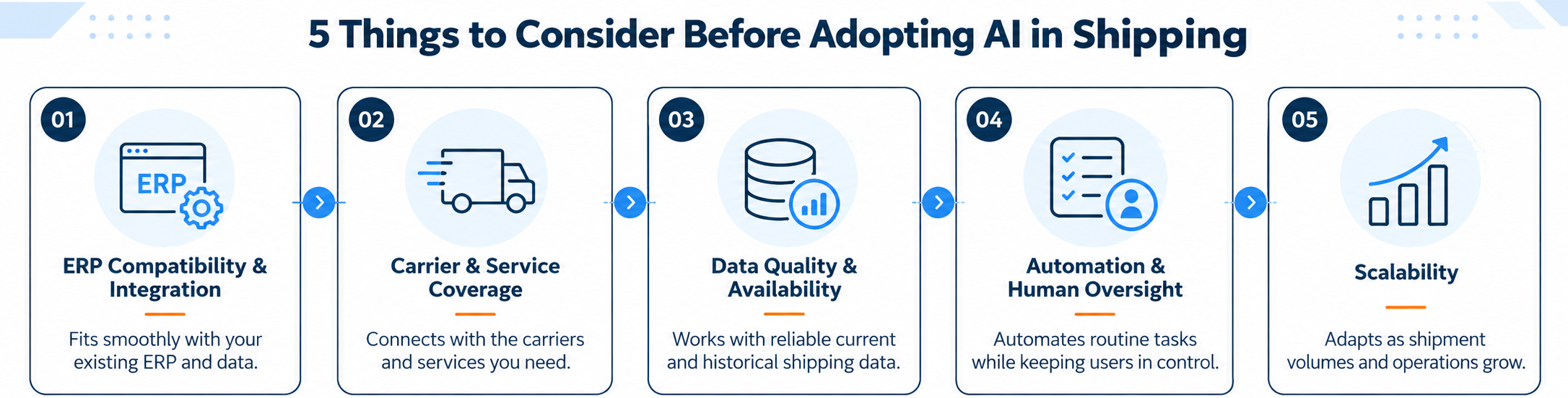
Many AI shipping tools weren’t built for enterprise ERP. Before you choose one, ask about these:
- ERP compatibility and integration: Does the AI run on a platform with native ERP integration? It should work from your live order and shipment data out of the box, with no exports or workarounds. If that isn’t there on day one, don’t expect it later.
- Carrier and service coverage: Next, look at the carriers it supports and where. When the tool compares rates, you want it looking at all the options you actually have. If it only checks two or three accounts, you could still be leaving money on the table.
- Data quality and availability: Let’s be honest, most shipping data is messy. The tool should handle it anyway and hand back clean data you can actually use for audits and forecasts.
- Automation with human oversight: It should automate routine decisions, flag errors early, and allow a person to step in when needed.
- Scalability: What works at today’s volume has to work at next year’s too. As shipping gets bigger and more complex, speed and accuracy shouldn’t slip.
Why Oracle ERP Depth Is the Real Differentiator
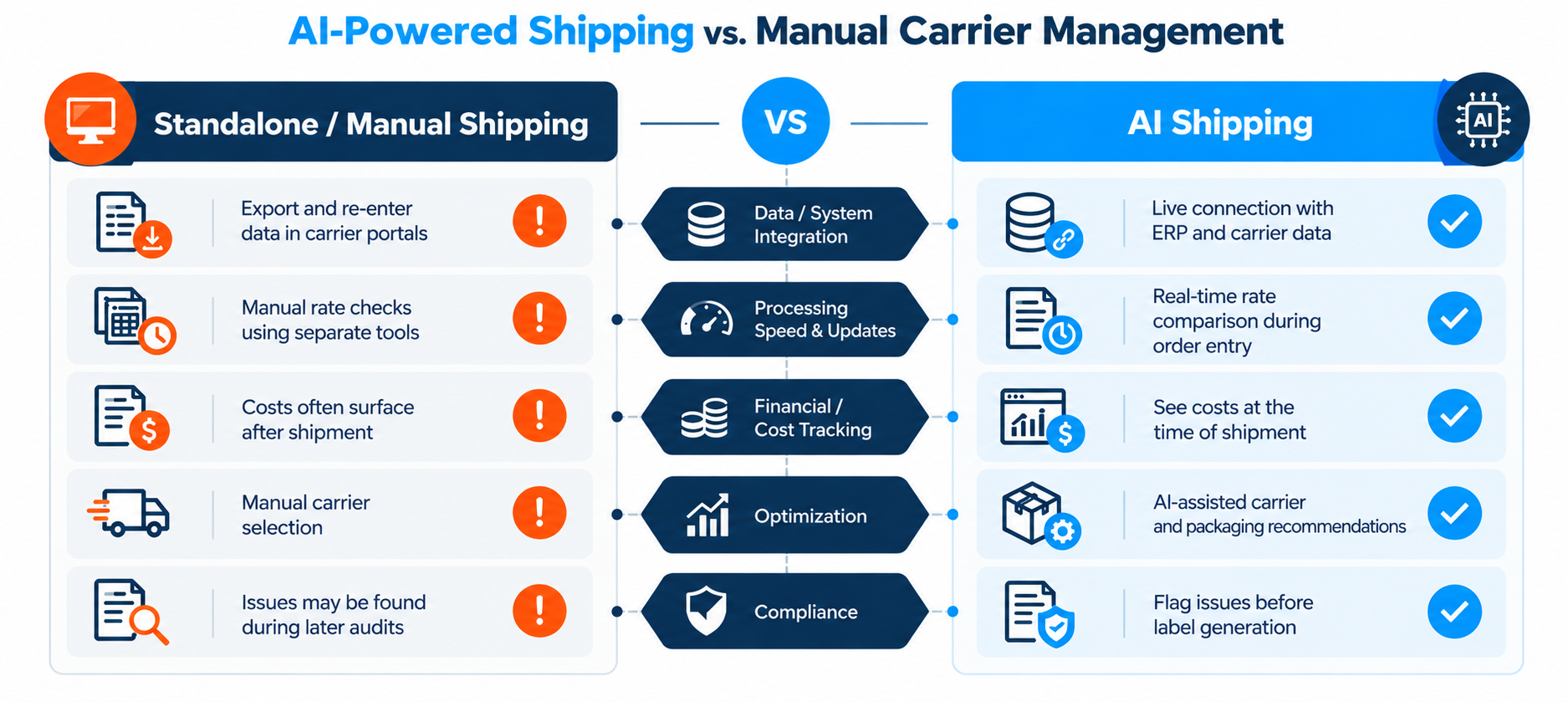
AI is only as smart as the data it can see. Most standalone AI shipping tools, and the ones built for e-commerce sellers in particular, don’t see much. Somebody has to export the data or type it in by hand, and the full order, customer, and shipping history in your ERP never makes it in.
ShipConsole takes a different approach. It integrates natively with Oracle EBS, Oracle Fusion Cloud, JD Edwards, and NetSuite out of the box, so order and shipment data moves straight between your ERP and the shipping platform. ShipConsole’s AI capabilities work on that same data. Every recommendation it makes, whether it’s a carrier selection, a packaging suggestion, or a compliance flag, is based on real order and shipment history from your system of record. No spreadsheet exports are involved.
Add a wide carrier network, including FedEx Compatible, UPS Ready, and USPS eVS certified integrations, along with a large LTL network, and you have real choices on every shipment. A tool connected to only two or three carriers doesn’t have much to recommend. The more carriers in the mix, the more value automated carrier selection can actually deliver.
Deep Oracle integration plus wide carrier access. That’s when AI-powered shipping starts saving enterprise teams real money and cutting errors.
How ShipConsole Delivers AI-Powered Shipping
ShipConsole connects out of the box to Oracle EBS, Oracle Fusion Cloud, JD Edwards, and NetSuite, as well as other ERPs such as Microsoft Dynamics 365. Because it’s integrated with your ERP, your system of record remains unchanged.
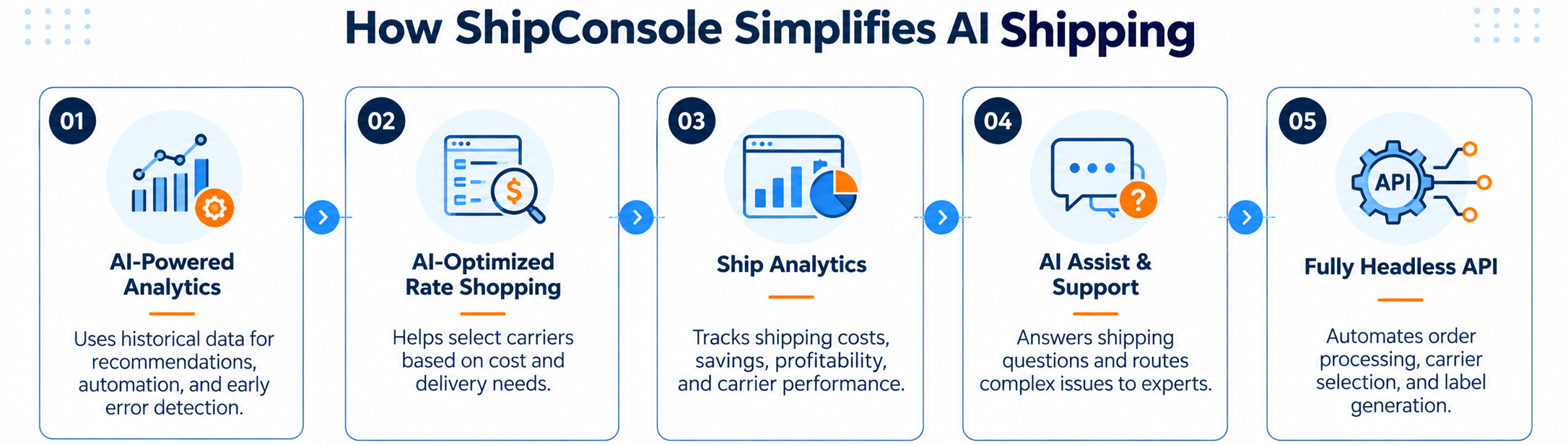
ShipConsole’s AI works in four areas: AI-Powered Shipping, Headless API & MCP Server, AI-Powered Implementation, and Support & Knowledge Base.
AI-Powered Shipping
Ship Assist recommends the right carrier, flags shipments likely to cause compliance issues before they leave, and suggests packaging that reduces DIM weight costs.
- AI-Powered Rate Shopping: When an order is ready to go, ShipConsole pulls up live rates from multiple carriers and recommends the best carrier. That pick is based on historical performance, pricing, and delivery reliability.
- Smart Packaging Recommendations: Measuring every item and guessing box sizes takes time. ShipConsole learns from your past shipments, like item sizes and order patterns, and suggests the right box for each order.
- Address Validation: A typo in an address can cost you more than you’d think. ShipConsole checks each address before printing the label and catches small mistakes or missing info right away. Fewer packages come back, fewer deliveries fail, and you don’t pay carriers to clean up address errors.
- Special Services Handling: Not every order is a simple pick, pack, and ship. Some need extra care, like cash-on-delivery orders or boxes of hazardous materials, and carriers are strict about how you handle them. Ship Assist flags shipments that are likely to cause compliance issues before they ship.
- AI-Powered Analytics: The AI tracks savings opportunities, freight profit, and carrier SLA performance using historical data. It flags problems early so you can fix them before they become patterns.
Headless API & MCP Server
Some teams don’t need a screen. ScAPI, ShipConsole’s headless REST API, runs the whole shipping engine in the background. The MCP Server builds on ScAPI, so AI copilots and agents can find and use live shipping data when someone asks in plain language.
ScAPI also runs AI Agents that handle shipping workflows from start to finish. They use the same secure carrier layer as the rest of your setup, so routine work keeps going without anyone clicking through each step.
AI-Powered Implementation
Implementations usually drag because of testing and rework. ShipConsole uses AI to write test scripts, suggest setup options, and catch errors early on. Your team can go live sooner, with far less back-and-forth.
Support & Knowledge Base
Ask a shipping question in plain language and get an answer from real implementation history. ShipConsole’s support teams in the USA and India are also available 24/7.
The Takeaway for Oracle ERP Teams
AI works best in shipping when it’s built in, not bolted on. For Oracle ERP users, the real value comes from AI that already understands your order data, customer history, and carrier options. That’s how AI leads to fewer shipping errors, better carrier choices, and real savings.
Want to see how this works with your own Oracle ERP data? Book a demo with ShipConsole, and we’ll walk you through it.
FAQs
Does adopting AI-powered shipping require replacing our ERP?
No. It's built to work with Oracle EBS, Fusion Cloud, JD Edwards, and NetSuite, not replace them. Your ERP and your team's workflow stay the same.
How does AI rate shopping reduce freight spend?
It compares live rates across multiple carriers in real time and recommends the option that best balances cost, delivery speed, and reliability, often within seconds.

Pavan Telluru is the Product Manager at ShipConsole. He brings over 15 years of experience to his role and is dedicated to conducting product demos for prospects and partners on how organizations can efficiently manage their shipping execution process. He also leads marketing efforts at ShipConsole.