Why is LTL freight shipping still this complicated?
Managing LTL freight often means working across too many systems. A shipment may be ready in Oracle, but rates still need to be checked in multiple carrier portals. Shipment data must be re-entered into booking tools. The Bill of Lading is created in one system, while freight labels are printed in another. Later, someone still has to update the ERP with freight costs and tracking numbers. This takes time and creates unnecessary work for shipping teams.
ShipConsole removes all of that. From the ERP delivery screen, a shipping team can rate, book, generate the BOL and labels, capture the signature, and sync everything back to Oracle. It happens in a click or two, not several separate tasks.
One connected workflow.
Freight shipping software should eliminate the need to switch between systems. ShipConsole does this by making the ERP delivery the center of the process. The team stays on one screen. Everything below happens automatically once the shipment is processed.
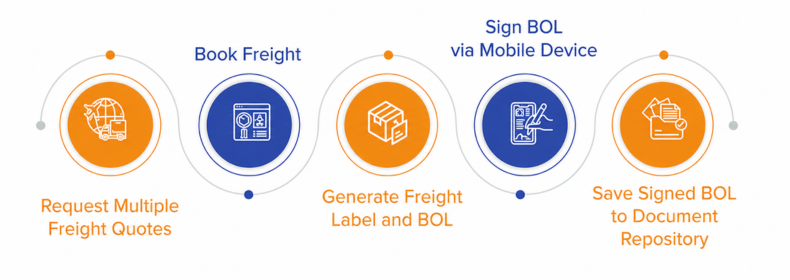
Here’s the order in Oracle, picked, released, and sitting ready to ship. That’s the moment ShipConsole steps in. A warehouse user scans the shipment number into ShipConsole, and every piece of shipping data flows straight into ShipConsole from the ERP, live, no manual re-entry. From there it’s a single click to pull quotes and lock in the best service, print the BOL and freight labels, and book the carrier, all without leaving one screen. Once that’s done, the details write back to your ERP and the ship confirm wraps up right inside the shipping platform.
ShipConsole integrates with Oracle EBS, Oracle Fusion Cloud, NetSuite, JD Edwards, and Microsoft Dynamics 365.
Freight details are ready before rating.
Handling units, freight class, weights, dimensions, NMFC codes, and hazmat details are already in place before rates are requested. Complete shipment data upfront helps carriers return more accurate rates. This reduces reweigh charges, reclass fees, short-pays, and billing disputes.
Accessorials are captured up front.
Services such as liftgate, residential delivery, inside delivery, oversized handling, freeze protection, and hazmat shipping are added before rating. Adding accessorials before rating helps carriers price shipments correctly. It also improves BOL accuracy and reduces unexpected charges later.
Rates are compared, and the shipment is booked.
ShipConsole pulls live LTL rates from your contracted carriers using direct carrier APIs and SMC3 rate tables. Costs, transit times, fuel surcharges, and accessorial charges are shown side by side. Once a carrier is selected, ShipConsole rates the shipment, books it, schedules pickup, and generates the pro number. No separate carrier portals.
BOLs and freight labels generate automatically.
Every BOL and label we generate comes out fully populated, shipper and consignee details, the commodities and their freight classes, dimensions and weights, any accessorial instructions, plus carrier PRO numbers and barcodes. Your warehouse team can print on the spot and get the freight moving right away. And because we pull every document from the same shipment record, your numbers stay consistent across the board, which means far fewer billing disputes down the line.
Electronic BOL signatures are captured.
When the driver arrives, we bring the BOL right up on a tablet or mobile device through the ShipConsole mobile app. The driver, shipper, or requester signs it on the spot, and we save that signed copy automatically to your document repository. From there, you can email the signed BOL to whoever needs it or keep it stored centrally, so your team can pull up any record the moment they need it.
Freight costs and tracking sync back to Oracle.
When processing is complete, ShipConsole automatically updates Oracle. Freight costs, carrier details, tracking numbers, and shipment status are updated back to the ERP. Oracle ends up with a complete shipment record for invoicing, freight audits, reporting, and customer support.
Built for domestic and international freight
Many LTL systems support only domestic shipments. ShipConsole supports both domestic and international shipments. It can generate commercial invoices, Shipper’s Letters of Instruction (SLIs), customs documents, and other international paperwork. International freight follows the same process as domestic shipments, so teams can manage both through one workflow.
Multi-carrier LTL connectivity
ShipConsole supports workflows across the contracted carriers in your network, including ABF Freight, Old Dominion, XPO Logistics, FedEx Freight, R+L Carriers, PITT OHIO, C.H. Robinson and many more.
Why Oracle shipping teams use ShipConsole
Faster shipment processing.
Shipping teams work faster because they no longer switch between ERP screens, carrier portals, BOL systems, and label tools. So teams can process more shipments in less time.
Fewer billing disputes.
Billing issues are reduced because rates, bookings, labels, BOLs, and freight costs are all derived from a single shipment record. This helps reduce data mismatches and billing issues.
Reduced accessorial charges.
Accessorials are captured before rating and booking. This helps carriers price shipments correctly and reduces billing charges later.
Complete shipment records.
Each shipment includes a full audit trail linked to the Oracle delivery record. It includes freight rates, carrier details, BOLs, labels, signed PODs, and tracking information. This makes reporting, freight audits, and carrier reviews easier. ShipConsole analytics dashboards give real-time visibility into shipping performance and freight costs.
See it in your ERP
With ShipConsole, the entire LTL shipping process runs on a single screen across all your contracted carriers. The platform integrates directly with Oracle EBS, Oracle Fusion Cloud, NetSuite, JD Edwards, and Microsoft Dynamics 365.
Request a personalized demo to see how ShipConsole automates LTL freight shipping inside your ERP environment

Pavan Telluru is the Product Manager at ShipConsole. He brings over 15 years of experience to his role and is dedicated to conducting product demos for prospects and partners on how organizations can efficiently manage their shipping execution process. He also leads marketing efforts at ShipConsole.