
Introduction:
FedEx just released its 2026 peak season demand surcharges, and the numbers are up again. The residential demand surcharge on Ground packages now tops out at 80 cents per package, up 23.1 percent increase over last year. Additional handling fees now peak at $11.85 per package. Oversize charges reach $117.25 per package. None of that is little money once you’re moving real volume through the fourth quarter.
For companies shipping multiple packages into the same country during peak season, FedEx International Priority DirectDistribution (IPD) is worth a closer look. This FedEx consolidated shipping approach won’t make the new surcharges disappear. But it does change how much operational friction you’re carrying while they’re in effect. That distinction matters before the surcharge windows open at the end of September. This article covers what FedEx IPD is, how it works, and how it can help you manage international shipments during peak season.
What Is FedEx International Priority DirectDistribution?
FedEx International Priority DirectDistribution groups multiple packages headed to the same destination country into one shipment. Instead of clearing customs forty or four hundred times, the whole batch clears once. It moves under a single Consolidated Commercial Invoice and one master air waybill. Once it clears, FedEx splits the shipment apart. Each package then goes to its recipient through FedEx’s regular domestic network in that country.
It’s a contractual service, so your FedEx account executive has to turn it on for your account. Also worth noting: consolidated shipments generally require an AES filing once value exceeds $2,500, though the actual EEI/AES trigger is assessed per Schedule B line item, per USPPI, per consignee, and per export day, not simply by total shipment value. It’s advisable to confirm this against Census Bureau AES guidance for your specific shipment.
Source: https://www.trade.gov/filing-your-export-shipments-through-automated-export-system-aes
How FedEx International Priority DirectDistribution Works
- Packages going to the same destination country are grouped into one shipment at origin.
- That shipment clears customs once, as a single entity.
- FedEx deconsolidates it after clearance.
- Each package goes out for last-mile delivery on its own.
FedEx’s 2026 Peak Season Surcharges, by the Numbers
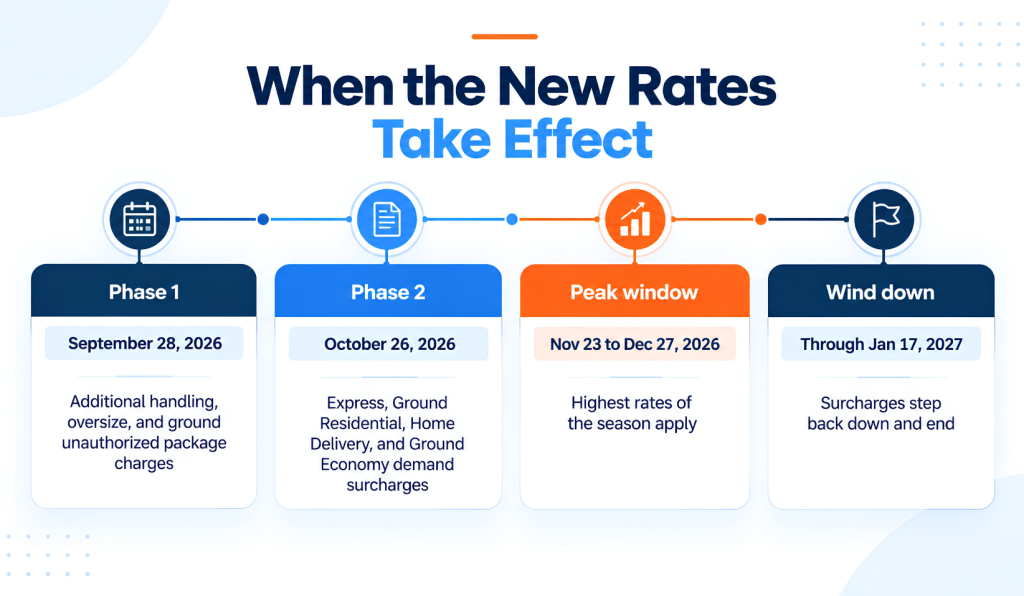
Timeline of FedEx’s 2026 peak season surcharge phases, from September 28, 2026 through January 17, 2027.
FedEx confirmed the 2026 peak season schedule in late July. Here is how the timeline runs:
Additional Handling, Oversize, and Ground Unauthorized Package surcharges begin first, on September 28. Most other surcharges follow on October 26. These cover Express, Ground Residential/Home Delivery, and Ground Economy. The highest rates apply during the peak window: November 23 through December 27, 2026.
Where Does the Money Actually Go at the Peak of the Season?
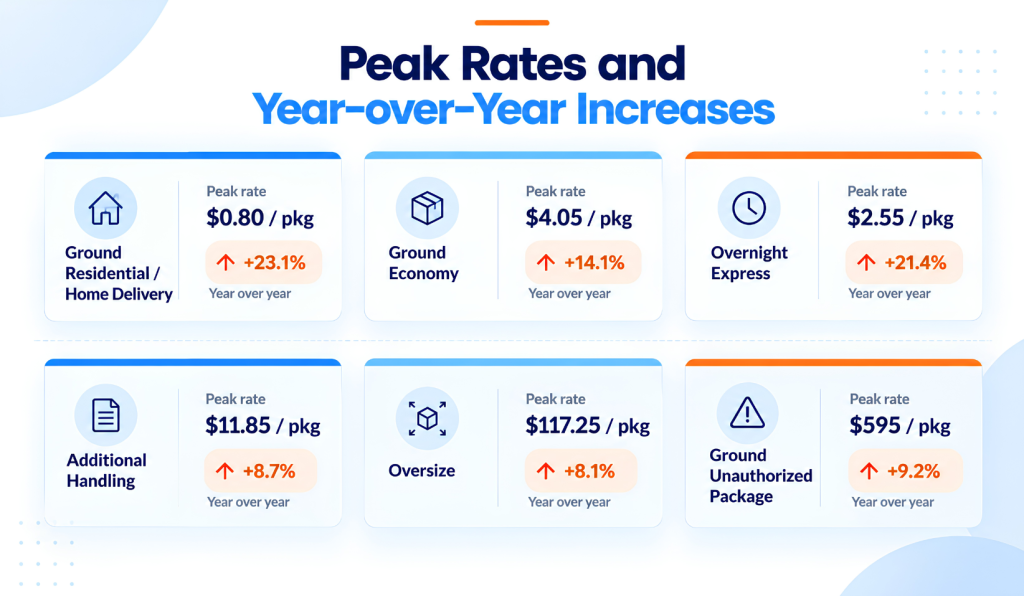
FedEx 2026 peak rates and year-over-year increases by surcharge type.
The standard Ground Unauthorized Package Charge is $1,875 per package in 2026. During peak season, FedEx also applies a Demand Unauthorized Charge of $535 per package, rising to $595 between November 23 and December 27, 2026. A package that triggers both could face between $2,410 and $2,470 in penalties, depending on the week, before fuel and transportation charges are added. FedEx says its demand surcharges reflect “elevated volumes, high demand for capacity, and increased operating costs across our network.” FedEx also described 2025 as its most profitable peak season ever, which is useful context if you are negotiating rates this year.
FedEx points to higher volume and higher operating costs as the reason for the increases. Worth noting: 2025 was already FedEx’s most profitable peak season on record. Keep that in mind if you’re pushing back on rates this year.
Not sure how these increases hit your own shipment mix? Get a free FedEx peak-season rate review from ShipConsole →
How Do FedEx’s 2026 Peak Season Surcharges Affect FedEx IPD?
FedEx also updates its export demand surcharges by destination lane every few weeks. If you’re using IPD to consolidate outbound shipments to a single destination country, the rate that applies to you is the export rate for that lane, not an import rate. Europe, Latin America, MEISA, and APAC destinations are each priced differently, with typically a $1 minimum per package regardless of lane. Because these rates get revised roughly every four to eight weeks, check FedEx’s current U.S. export demand surcharge schedule for your specific destination countries before locking in Q4 pricing.
Here’s the part that actually matters for IPD: demand surcharges like these are generally applied per package or by weight. They don’t disappear just because the packages are traveling as part of a consolidated shipment. Running your international volume through IPD isn’t a way around this year’s fee increases. What it does is cut down on how many separate customs entries, invoices, and broker touchpoints you’re juggling. That matters most right now, when volume and the odds of something going sideways, is at its highest point of the year.
How Does FedEx Consolidated Shipping Help During Peak Season?
If IPD doesn’t cancel out the new surcharges, why does FedEx consolidated shipping matter more right now than in a slower quarter? A few reasons hold up. FedEx consolidated shipping reduces the number of separate clearance events and shipment records your team needs to manage during peak season:
- Fewer clearance events mean fewer chances for a paperwork error. That matters most during the exact weeks when customs offices, brokers, and your own team are stretched thinnest.
- Less reliance on local warehousing at destination, exactly the kind of space that gets tight and expensive in the weeks before a holiday peak.
- One shipment record to track instead of dozens, which matters more when a delay anywhere in the chain is harder to catch quickly during the busiest stretch of the year.
None of that offsets the new per-package rates directly. It just means the packages you’re moving spend less time exposed to the kind of manual, error-prone handling that tends to get worse, not better, as volume climbs.
How Can FedEx IPD Help Businesses Prepare for Peak Season?
- Confirm your IPD service is active. Make sure your account executive knows your expected fourth-quarter volume increase ahead of time, not after it shows up.
- Check whether your consolidated shipment volume could exceed 40 packages during peak weeks. FedEx supports asynchronous processing for larger shipments. Make sure your batch-processing workflow is tested before demand rises.
- Verify your AES filing process holds up at higher volume. A workflow that’s fine at ten shipments a week can quietly break at a hundred.
- Review your shipment lanes. Every destination country you consolidate to under IPD now carries updated export demand surcharges on top of standard rates, check the current per-pound rate for each lane before locking in Q4 landed-cost forecasts.
- Build the surcharge windows above into your landed cost forecasts for Q4 orders now, rather than discovering them on an invoice in December.
How Can ShipConsole Help Manage FedEx International Priority DirectDistribution During Peak Season?
ShipConsole is a FedEx compatible shipping partner and supports the FedEx IPD process for companies running FedEx through Oracle. This peak season brings higher surcharges across nearly every service tier. The bigger risk usually isn’t FedEx’s process itself. It’s whether your shipment data stays accurate and fast once volume climbs, data that comes straight from your Oracle order and fulfillment records.
That’s the piece ShipConsole automates. It pulls shipment data straight from Oracle ERP. It builds and prints IPD consolidated shipments and labels. It flags AES and documentation gaps before they turn into a hold at the border. And it gives you a way to test the setup ahead of time, so you’re not finding out what breaks in the middle of November.
Do peak season surcharges apply to consolidated IPD shipments?
Generally, yes. Demand surcharges apply per package or by weight. Consolidating shipments under IPD doesn't exempt individual packages from these fees. What it does reduce is the number of separate customs clearances and paperwork you're managing at once.
Do I still need an AES filing for IPD shipments over $2,500?
Yes, that requirement hasn't changed. Consolidated shipments valued over $2,500 still require an AES filing.
Are there separate demand surcharges by shipping direction?
Yes. Export surcharges apply for outbound IPD shipments, priced by destination lane and revised every few weeks. Import surcharges apply for inbound shipments into the U.S., up to $0.35/lb from China, Hong Kong, and Macau, and up to $0.20/lb from Japan, South Korea, Singapore, Taiwan, and Australia.
Running FedEx IPD through Oracle and want to see if your setup can handle peak-season volume? Request a ShipConsole demo to see how it holds up.

Pavan Telluru works as a Product Manager at ShipConsole. He brings over a decade of experience to his current role where he’s dedicated to conducting product demos to prospects and partners about how to organizations can efficiently manage their shipping execution process. He also leads marketing efforts at ShipConsole.