
Key Highlights:
- Middleware gives IT more control, but each custom carrier connection adds maintenance
- Xerox reported spending over 90% less time processing shipments.
- An overview of how Oracle shipping integration works with middleware in comparison to shipping software that directly integrates with Oracle.
Introduction
Many companies rely on middleware for Oracle shipping integration to connect their ERP systems with carriers like FedEx and UPS as part of their Oracle shipping execution process.
The use of a middleware-based approach for Oracle ERP shipping integration can result in issues with the carrier update process. Carrier updates can cause label printing to fail and thus disrupt warehouse operations. During the time it takes for IT to resolve the coding problem, warehouse operations will cease. Many organizations have decided to use multi-carrier shipping software that is integrated into Oracle and provides automatic updates of carrier information to minimize disruptions caused by carrier updates.
How Oracle Shipping Integration Works Through Middleware
A typical middleware-based Oracle shipping integration setup works as follows:
- The shipping process starts when a delivery is ready to ship in Oracle EBS, Oracle Fusion Cloud ERP, or JD Edwards.
- Middleware takes the data in real time or on a schedule.
- It translates the data for the carrier and sends the request.
- The carrier sends back a label and tracking number, which the middleware saves in Oracle.
Now, repeat this process for every carrier you use. Each one needs its own setup, mapping, and fixes. Extra tools like rate shopping, address checks, international paperwork, and hazmat shipping require extra setups. Often, they never get built.
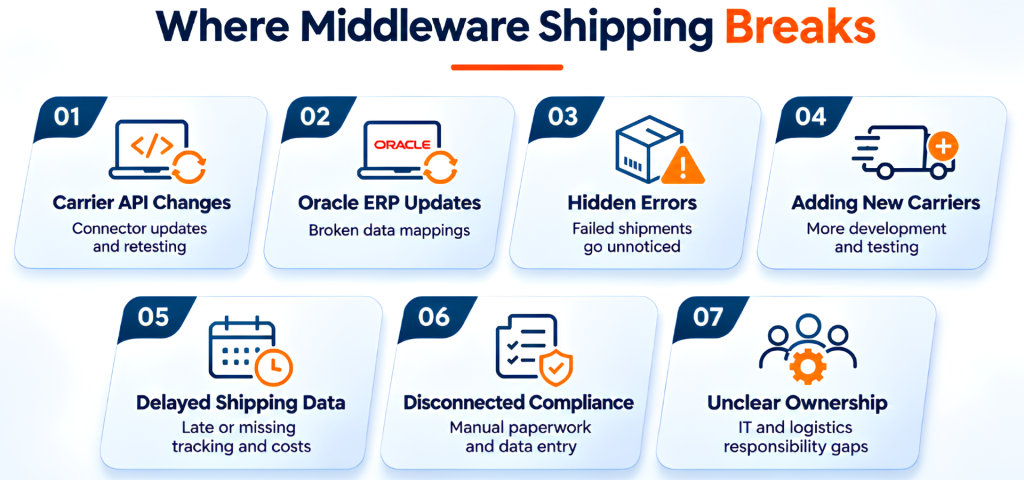
7 Common Challenges with Middleware-Based Oracle Shipping Integration
None of these problems are rare. If your shipping runs through middleware, you’ve likely run into several of them.
- A carrier changes its API
Carriers update their system at the time of day that works best for them, not when it is convenient for you. For example, UPS and FedEx have both changed how shipping software authenticates with their APIs. Each update requires your IT staff to make changes, test, and apply updates to the programming. When you do not meet the carrier deadline, your shipping will cease immediately.
- Oracle releases can break the integration
Oracle provides frequent updates. Your middleware could be affected by those updates. If you use Oracle Fusion Cloud, EBS, or JD Edwards, Oracle system updates can affect how the Oracle shipping execution process operates and create connectivity problems with your carrier. Many times, you will realize you have an issue with your system when the number of unshipped orders grows larger than normal in the warehouse.
- Errors fail quietly
When there is an issue with the middleware, the error message is placed into an IT queue that is not accessible to the warehouse team. The shipping team only sees an order without a label attached to it. It could be too late for the delivery truck to leave the warehouse by the time someone identifies and resolves the issue.
- Adding a carrier turns into a project
When you add a new carrier or freight partner into your Oracle carrier integration system, you have to build a new connection from scratch. A quick setup becomes a slow IT project. Because it takes so long, many companies stick with their current carriers. They do this even when they can get better rates elsewhere.
- Shipping data comes back late or incomplete
Many times, when middleware is used with Oracle ERP to facilitate shipping integration, the data sent to Oracle is done so in batches. As such, it takes a long time (sometimes even days) for tracking numbers, shipping costs, and delivery updates to be received by Oracle. In some cases, the data is never received by Oracle. Finance will need to use average shipping costs as estimates for invoicing. Customer Service will need to exit Oracle and go directly to each carrier site to obtain tracking information.
- Compliance sits outside the flow
Middleware often doesn’t handle international shipping documentation or hazmat paperwork. Instead, the shipping department prepares these documents manually or uses other software systems. That means retyping data that’s already in Oracle. This manual data entry often leads to typos, customs delays, and shipping errors.
- Nobody really owns the carrier layer
IT manages middleware. Logistics deal with the shipping delays it causes. When something goes wrong, teams can spend hours deciding who should fix it. Finding the fix is hard too. The developers who built it have often left without writing down how it works.
Middleware for Oracle Shipping Integration: Pros and Cons
Let’s go through the pros and cons of Middleware for Oracle Shipping Integration before comparing it with Direct Multi-Carrier Shipping Software.
| Pros | Cons |
|---|---|
| Uses integration tools and skills you may already have | One connector per carrier, each built and maintained separately |
| Complete control over how data is shared and directed | It breaks whenever carriers change their systems or Oracle gets updated |
| You can connect shipping to other systems like your warehouse, online store, or trading partners all in one place | Rate shopping, address checks, paperwork, and hazmat shipping all require separate setups |
| No new vendor to bring on, at least at the start | Errors are hard to spot from the warehouse floor |
| Works well for non-shipping tasks like syncing customer data or importing online orders | Batch syncs delay tracking and freight cost data |
| Can be customized to fit very unusual workflows | Troubleshooting and updates depend on a few people who understand the custom setup. |
| Keeps data flows inside your own IT environment and under your own control | Ongoing development cost, not a one-time build |
What Direct Oracle Shipping Integration Looks Like
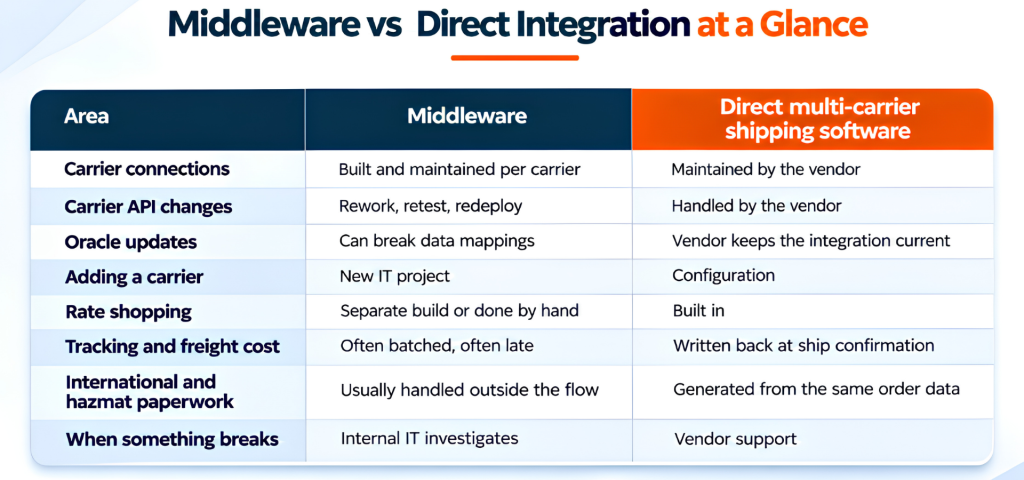
The best way to do Oracle shipping integration is by utilizing multi-carrier shipping software. It has the ability to integrate with your Oracle system, rather than having to build and maintain custom connection points with each of the carriers you use. You can integrate Oracle with one shipping platform that will manage all of the connections with the carriers, updates to the APIs, and operations related to shipping.
The process becomes much simpler:
- Once a delivery is ready for shipment in Oracle, the shipping software retrieves the shipment information directly from the ERP.
- The shipper checks the rates, validates the address, and prints all labels and forms from a single screen.
- Tracking numbers, costs, and confirmations go back to Oracle automatically.
When FedEx or UPS updates their systems, the shipping software vendor fixes it. Your Oracle team doesn’t need to open a ticket, and the warehouse keeps shipping.
Direct Oracle Shipping Integration: Pros and Cons
Direct integration has its own pros and cons. Here is how it compares:
| Pros | Cons |
|---|---|
| No carrier connectors to build or maintain | You rely on the vendor supporting your Oracle version and your carriers, so confirm both before you buy |
| Carrier API changes are the vendor’s job | A subscription replaces part of your internal development cost |
| Rate shopping, labels, address validation, documents, and tracking in one workflow | Very unusual workflows may need business rules or configuration to fit |
| Tracking and freight cost written back to Oracle in real time | It doesn’t replace middleware for non-shipping integrations and is not intended to. |
| Adding a carrier is configuration, not a development project | Warehouse teams need to learn a new shipping screen and workflow |
| Compliance checks run before the package leaves the dock | Implementation takes time (typically 4 to 6 weeks) before go-live |
What Would Direct Shipping Look Like in Your Oracle ERP?
See how ShipConsole connects Oracle to your carriers and sends tracking numbers and shipping costs back automatically.
See It in Action
When Middleware Still Makes Sense for Oracle ERP Integration
Many times, middleware is still the best option for certain tasks (i.e., syncing customer data, importing online orders). Therefore, you may continue to use middleware for these types of tasks. However, when it comes to shipping, middleware is not the best choice because carrier systems are updated frequently, and shipping issues can negatively impact multiple departments within an organization. A custom carrier layer is another system that your IT department must monitor.
How ShipConsole Simplifies Oracle Shipping Integration
ShipConsole is a shipping solution that works right out of the box with Oracle ERP systems. It has been certified and validated by Oracle. ShipConsole is designed to work seamlessly with Oracle EBS, Oracle Fusion Cloud ERP, JD Edwards, and NetSuite, allowing you to connect your ERP system directly to parcel, LTL, and freight carriers such as FedEx, UPS, DHL, and USPS.With ShipConsole, there’s no middleware to build or maintain.
- Native Oracle integration: Processes deliveries as soon as they are available for shipment. The system automatically saves tracking numbers, shipping costs, and delivery confirmations in Oracle.
- Rate shopping: Compare live carrier rates by cost, delivery time, or service level. Business rules can automatically select the best carrier for you. So, shippers don’t have to choose manually.
- Address validation and labels: Addresses are checked before label printing to avoid correction fees and returns.
- International compliance: International shipping and customs documents are created from the same order data used for shipping. For U.S. exports that require Electronic Export Information (EEI), it files through ACE and pulls back the Internal Transaction Number (ITN).
- Hazmat: ShipConsole supports shipping hazardous materials via UPS, FedEx, and USPS. Hazmat information can be imported into ShipConsole from Oracle. Before creating a shipping label for each package, ShipConsole verifies that all hazardous materials comply with each carrier’s rules. Documents such as OP-900, Shipper’s Declaration, and End-of-Day Hazardous Materials Reports are automatically generated. For additional information about dangerous goods, read our hazmat compliance blog.
- Built for the whole enterprise: It is available as cloud-based enterprise software, so there’s no need to install and maintain a system at each location. Adding a new carrier, account, or warehouse location is a configuration step, not a development project.
- Reporting and analytics: All data is available through reports and dashboards. Finance sees the freight cost of each order the moment it ships. The logistics team can easily track carrier performance and spending.
In a Nutshell:
Middleware gave many Oracle shipping teams a starting point, and some still rely on it today. But each carrier you add, and each system update you face makes that setup tougher and costlier to maintain. Direct multi-carrier shipping software takes the carrier layer off your IT team’s plate and puts shipping data directly on the Oracle order. Many teams keep middleware for non-shipping integrations and use direct shipping software for the carrier layer.
If you are planning to rebuild your middleware or facing another system update from a carrier, consider a direct approach to Oracle shipping integration first. Book a demo, and we’ll walk you through ShipConsole using shipping scenarios tailored to your requirements.
FAQs
Can Oracle Shipping Integration handle International and Hazmat shipments?
Yes, direct integration can provide customs documents, commercial invoices, and hazmat details from the same order data used to ship. This reduces delay and errors.
Will I have to replace my existing Oracle shipping execution setup?
No, ShipConsole integrates with your existing Oracle shipping execution workflow instead of replacing your current shipping process. It adds the carrier connection while allowing your existing Oracle workflows to continue.

Pavan Telluru is the Product Manager at ShipConsole. He brings over 15 years of experience to his role and is dedicated to conducting product demos for prospects and partners on how organizations can efficiently manage their shipping execution process. He also leads marketing efforts at ShipConsole.